Warm vs Cool Undertone Skin
Clear tests to identify whether you have warm, cool or neutral skin undertones — plus the foundation, jewellery and clothing colours that flatter each.
Your skin's surface colour (light, medium, deep) is one thing. Your undertone — the colour underneath — is what actually drives which shades flatter you. Here's how to read yours.
Surface tone vs undertone
Surface tone changes with sun, season, sleep and hormones. Undertone doesn't — it's the constant warmth or coolness beneath. Two women with the same fair surface can have completely opposite undertones.
Signs you're warm-toned
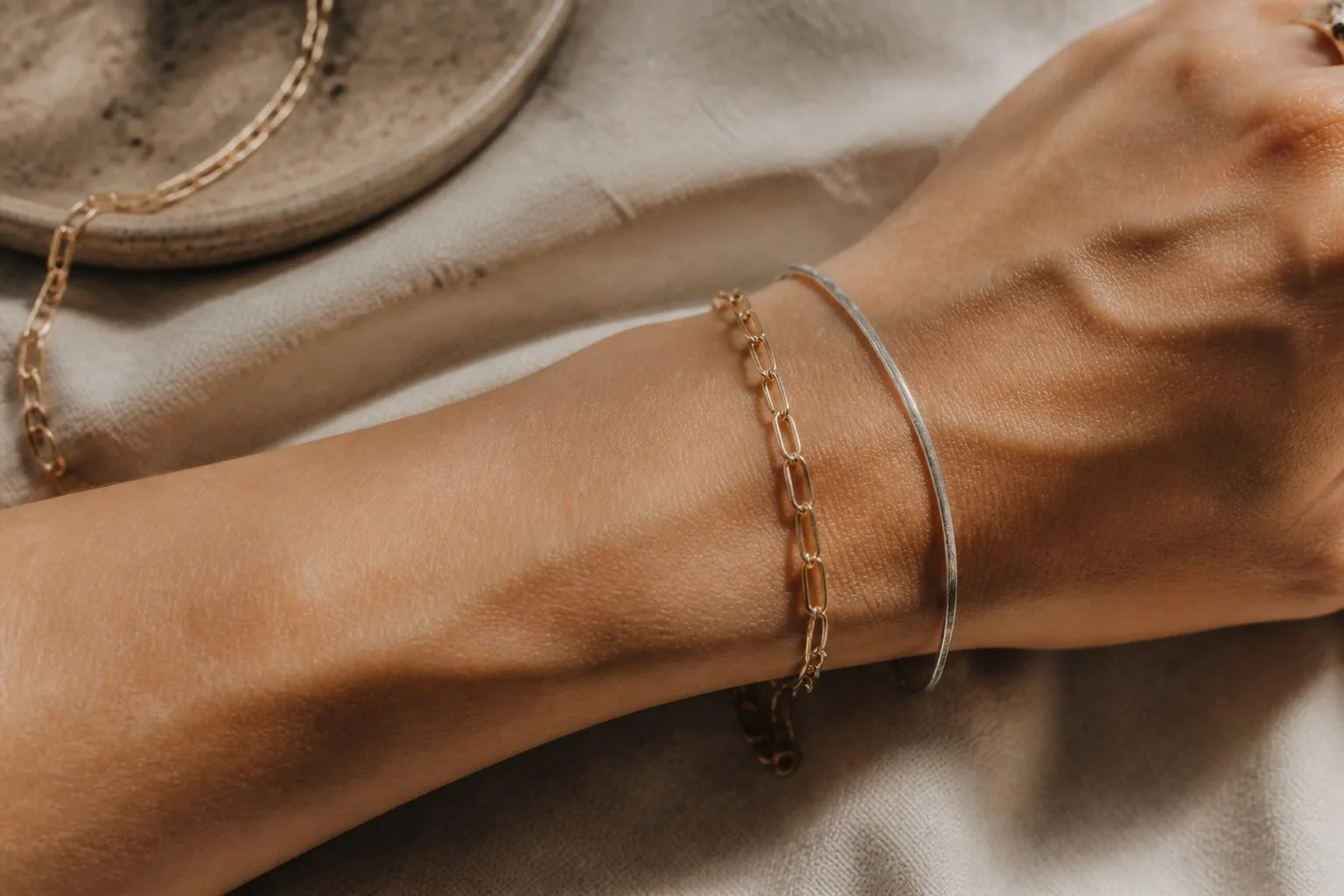
- Gold jewellery looks naturally at home
- You tan easily and rarely burn
- Veins appear greenish in daylight
- Cream, ivory and warm white flatter you more than pure white
- Hair has natural golden, red or copper highlights
Signs you're cool-toned
- Silver jewellery suits you better than gold
- You burn before you tan
- Veins appear blue or purple
- Pure white and icy pastels brighten your face
- Hair has natural ashy, platinum or blue-black tones
Signs you're neutral
Both gold and silver work, vein colour is hard to call, and you can wear pure white and cream without either looking off. Neutral undertones are more common than people think — roughly one in three clients.
Choosing foundation by undertone
Most Perth chemist brands label foundations with W (warm), C (cool) or N (neutral) codes. Match this to your undertone, not your surface depth. A warm fair skin needs W shades; a cool deep skin needs C shades. Getting this wrong is why foundation 'doesn't match' even when the depth is right.
Frequently asked questions
Can my undertone change with age?
No — undertones are genetic. What changes is melanin density and skin clarity, which can shift your surface depth but not your underlying warm/cool axis.
Is olive skin always warm?
Surprisingly, no. Olive complexions often have neutral or even cool undertones beneath the greenish surface cast. Professional draping is the most reliable way to confirm.
Why undertone matters more than surface tone
Foundation brands have spent the last decade improving shade ranges — 40+ shades is now standard. But shade depth alone doesn't fix mismatched makeup. If your foundation depth is right but the undertone is wrong, you'll see it as orange around the jaw, grey across the forehead, or a 'mask' line under harsh light. Matching undertone first, then depth, eliminates that problem.
The same logic applies to clothing. Two cream tops can have wildly different undertones — one warm-leaning ivory, one cool-leaning porcelain. A warm-undertone Perth woman looks healthy in the ivory and washed-out in the porcelain. Swap them and the effect reverses.
A more reliable undertone test
If the vein test left you uncertain, try this layered approach:
1. White paper test. Hold a piece of pure white printer paper next to your bare face in natural daylight. Warm undertones will look yellow or peach against the paper; cool undertones look pink or bluish; neutrals look balanced. 2. Eye colour clue. Warm undertones often have golden flecks in hazel, green or brown eyes. Cool undertones tend toward grey-blue, cool brown or olive-green. 3. Sun reaction over time. Warm skin builds a golden tan; cool skin tends to pink or stay pale; neutral does a bit of both. 4. Best-friend colour test. Think of one colour everyone always compliments you in. Camel, mustard, coral or olive points warm. Fuchsia, ruby, navy or icy blue points cool.
No single test is conclusive — agreement across three or four is.
Foundation shopping by undertone in Perth
Most Perth chemists and beauty counters (Priceline, Chemist Warehouse, Mecca, David Jones) carry undertone-coded shade ranges:
- W shades — yellow, peach, golden undertone. Try these if warm.
- C shades — pink, rose, bluish undertone. Try these if cool.
- N shades — balanced undertone. Try these if neutral.
Always test a stripe of three adjacent shades along the jawline, not the back of the hand. The shade that vanishes under natural daylight is yours.
How a Perth consultation confirms your undertone
In the Currambine studio, undertone is the first thing we lock in — usually within the first 15 minutes of draping. From there, the entire session builds outward: which whites you wear, which metals you choose, which lipstick you reach for. Book a session → to get the answer in person, or see pricing → for solo and group rates.
How undertone affects jewellery choice
Jewellery sits right next to your skin and shifts how the eye reads your undertone. Warm undertones look harmonious in yellow gold, copper and rose gold. Cool undertones come alive in silver, white gold and platinum. Neutrals can wear either and usually look great in mixed-metal pieces.
If you've ever felt your favourite necklace 'doesn't suit you anymore', it's often the metal — not the design — that's the issue.
How undertone interacts with lipstick
Lipstick is the fastest test of undertone. Warm undertones suit corals, warm reds, terracotta, brick and warm browns. Cool undertones suit berries, blue-reds, mauves, fuchsia and rose. Neutrals can wear muted versions of either family. If your lipstick consistently looks 'too much' or 'wrong' the moment you put it on, the undertone match is the most likely culprit — not the formula.
Why undertone is the foundation of personal colour analysis
Every other decision in a colour analysis session — value, chroma, sub-season — is built on top of undertone. Get undertone wrong and the entire palette falls apart. That's why in a Currambine session we lock undertone in first, with multiple drape comparisons, before moving on. By the end of the first 15 minutes you'll see for yourself which direction your skin lives in.
How undertone shows up in your wardrobe right now
Open your wardrobe and scan it. If most of your favourite, most-complimented pieces are in the warm family (camel, mustard, terracotta, ivory, olive), your undertone is likely warm. If they cluster in the cool family (navy, charcoal, rose, raspberry, true white), your undertone is likely cool. A wardrobe that has clear favourites in both warm and cool is a strong signal for neutral.
The clothes you wear least often are equally diagnostic — they're usually outside your undertone, which is why they 'never feel right'.
When to seek professional confirmation
If multiple self-tests disagree, your skin reads as olive or freckled, or you're navigating a grey-hair transition, in-person draping in a Perth session cuts through the ambiguity in 15 minutes flat.
Ready to discover your palette?
Book your personal colour analysis or makeup session with Sue in Currambine or across the Perth metro area.